If you own a small business and want more local customers, this Local SEO Checklist is exactly what you need.
Local SEO helps your business appear when people search for products or services in their area. Whether someone searches for “dentist near me,” “best coffee shop in Chicago,” or “roofing company in Dallas,” local search optimization helps your business show up where it matters most.
The good news is that local SEO is often easier and more affordable than competing nationally. Many small businesses still overlook important ranking factors such as Google Business Profile optimization, local citations, customer reviews, and location-based content. As a result, there is a significant opportunity for businesses that implement a proper local SEO strategy.
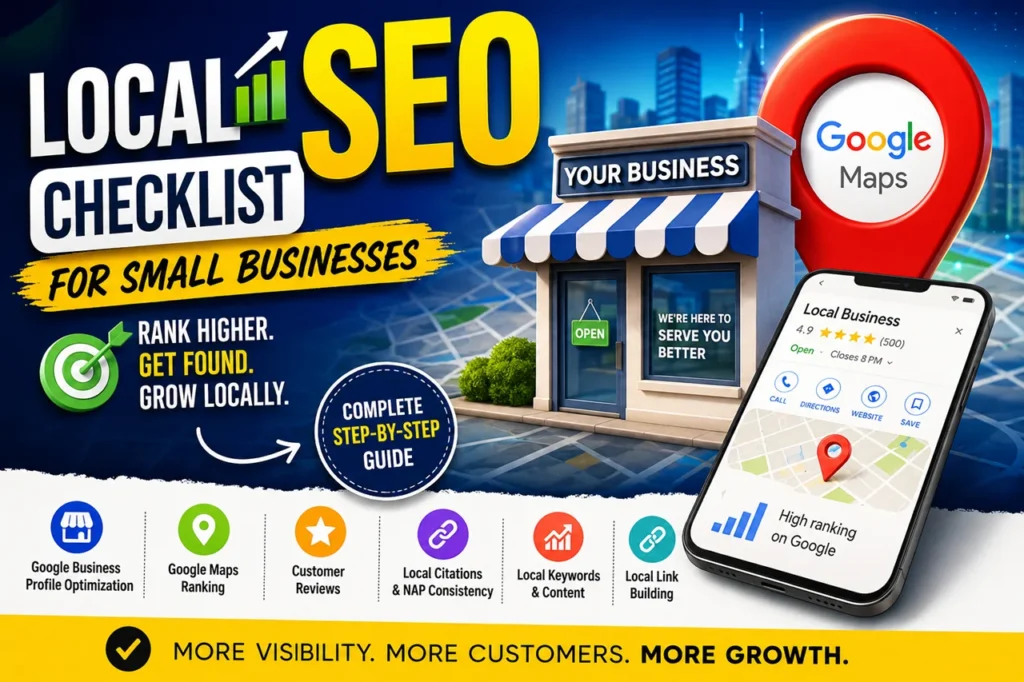
This guide provides a complete Local SEO Checklist for small businesses. It covers everything from Google Maps SEO and local keyword research to citation building, local link building, reputation management, and technical optimization.
By following the steps outlined in this guide, you can improve local search rankings, increase website traffic, generate more phone calls, and attract more qualified leads.
Table of Contents
- 1Key Takeaways
- 2Quick Facts About Local SEO
- 3What Is Local SEO?
- How Local SEO Works
- Why Local SEO Matters for Small Businesses
- 4Complete Local SEO Checklist for Small Businesses
- Google Business Profile Setup Checklist
- Website Optimization Checklist
- Local Keyword Research Checklist
- On-Page Local SEO Checklist
- Local Content Marketing Checklist
- 5Google Business Profile Optimization Checklist
- Select the Right Categories
- Optimize Products and Services
- Upload Photos Regularly
- Publish Google Posts
- Manage Questions and Answers
- 6Local SEO Audit Checklist
- Website Audit
- Google Business Profile Audit
- Citation Audit
- Competitor Audit
- 7Google Maps SEO Checklist
- Important Google Maps Ranking Factors
- Google Maps Optimization Best Practices
- Common Google Maps SEO Mistakes
- 8Local Citations and NAP Consistency
- What Are Local Citations?
- Why NAP Consistency Matters
- Citation Building Checklist
- 9Local Link Building Strategies That Improve Local Rankings
- Why Local Link Building Matters
- Best Local Link Building Opportunities
- Local Link Building Checklist
- 10Local Content Marketing Strategies
- Why Local Content Matters
- Create Location-Specific Service Pages
- Publish Local Guides
- Share Customer Success Stories
- Local Content Ideas
- 11Online Reviews and Reputation Management
- Why Reviews Matter
- Best Practices for Getting More Reviews
- Review Request Methods
- Respond to Every Review
- Handling Negative Reviews
- Review Management Checklist
- 12Technical Local SEO Checklist
- Mobile Optimization
- Improve Website Speed
- Local Business Schema Markup
- Create and Submit XML Sitemaps
- Fix Technical Errors
- 13Google Business Profile Optimization vs Traditional SEO
- 14Local SEO Tools Worth Using
- Free Local SEO Tools
- Paid Local SEO Tools
- What Tool Should Beginners Start With?
- 15Common Local SEO Mistakes Small Businesses Make
- Incomplete Google Business Profiles
- Inconsistent Business Information
- Ignoring Reviews
- Poor Mobile Experience
- Duplicate Listings
- Thin Location Pages
- Lack of Local Content
- 16Local SEO Checklist: Beginner vs Advanced Comparison
- 17Measuring Local SEO Success
- Key Performance Indicators
- Important Reports to Monitor
- 18Creating a Winning Local SEO Strategy for Long-Term Growth
- Step 1: Establish a Strong Foundation
- Step 2: Build Authority
- Step 3: Create Consistent Content
- Step 4: Monitor and Improve
- 19Multi-Location SEO for Growing Businesses
- Challenges of Multi-Location SEO
- Best Practices for Multi-Location SEO
- Example Structure
- 20Service Area Business SEO Best Practices
- How Service Area SEO Differs
- Service Area SEO Checklist
- Landing Page Example
- 21Local SEO Trends Shaping the Future
- AI-Powered Search
- Voice Search Optimization
- Visual Search
- User Experience Signals
- 22Real-World Example: How Local SEO Helps Small Businesses Grow
- Company A
- Company B
- 23Expert Opinion
- 24Author Expertise & Trust Signals
- 25Conclusion
- 26FAQs
- What is a Local SEO Checklist?
- How important is Google Business Profile for local SEO?
- How long does local SEO take to show results?
- What are local citations?
- How do reviews affect local rankings?
- What is NAP consistency?
- Do small businesses really need local SEO?
- Which local SEO activity should I prioritize first?
- Can local SEO help businesses without a physical storefront?
- What are the best local SEO tools for small businesses?
Key Takeaways
- Local SEO helps businesses appear in local search results and Google Maps.
- Google Business Profile is one of the most important local ranking factors.
- Consistent business information across the web improves trust and rankings.
- Customer reviews directly influence local visibility.
- Local keyword research helps target buyers in specific locations.
- Local citations and backlinks strengthen authority.
- Mobile optimization is essential for local search success.
- Regular audits help maintain and improve rankings.
- Local content marketing can drive highly targeted traffic.
- A complete Local SEO Checklist provides a roadmap for sustainable growth.
Quick Facts About Local SEO
| Factor | Importance |
|---|---|
| Google Business Profile | Very High |
| Customer Reviews | Very High |
| NAP Consistency | High |
| Local Citations | High |
| Local Backlinks | High |
| Website Optimization | High |
| Mobile Experience | High |
| Local Content | Medium to High |
| Social Signals | Medium |
| Behavioral Signals | Medium |
What Is Local SEO?
Local SEO is the process of optimizing a business so it appears in local search results.
Unlike traditional SEO, which focuses on ranking nationally or globally, local search engine optimization targets people searching within a specific geographic area.
For example:
- Emergency plumber in Miami
- Personal injury lawyer in Houston
- Best pizza near me
- Auto repair shop in Phoenix
These searches indicate strong local intent. Google wants to provide nearby and relevant businesses to users, making local SEO critical for service providers and local stores.
How Local SEO Works
Google evaluates several signals when determining local rankings:
- Relevance
- Distance
- Prominence
Relevance measures how closely a business matches a user’s search.
Distance considers how close the business is to the searcher.
Prominence evaluates reputation, authority, reviews, citations, and overall online presence.
Businesses that optimize these factors generally achieve better visibility in both local organic rankings and Google Maps.
Why Local SEO Matters for Small Businesses
Small businesses often have limited marketing budgets. Local SEO allows them to compete effectively against larger brands.
Benefits include:
- More qualified leads
- Higher conversion rates
- Better local visibility
- Increased foot traffic
- More phone calls
- Improved trust
- Stronger brand recognition
Many local searches result in a purchase within a short period. This makes local search traffic some of the highest-converting traffic available.
Complete Local SEO Checklist for Small Businesses
The following checklist covers the most important areas of local SEO.
Google Business Profile Setup Checklist
Your Google Business Profile is often the foundation of local SEO success.
Complete every section available.
Checklist:
- Claim your profile
- Verify ownership
- Use your official business name
- Add primary category
- Add secondary categories
- Add phone number
- Add website URL
- Add business hours
- Add holiday hours
- Upload logo
- Upload cover photo
- Upload team photos
- Upload office photos
- Add products
- Add services
- Create business description
- Enable messaging
- Add appointment links
- Publish regular updates
Website Optimization Checklist
Your website supports your Google Business Profile and local rankings.
Checklist:
- Mobile-friendly design
- Fast page speed
- Secure HTTPS connection
- Optimized title tags
- Optimized meta descriptions
- Internal linking structure
- Clear navigation
- Contact page
- About page
- Service pages
- Location pages
- Schema markup
- Call tracking setup
Local Keyword Research Checklist
Every successful local SEO campaign begins with keyword research.
Examples:
- Dentist in Austin
- HVAC company in Denver
- Family lawyer in Atlanta
- Local SEO services in New York
Research:
- City keywords
- Neighborhood keywords
- Service keywords
- Near-me keywords
- Competitor keywords
- Question-based keywords
On-Page Local SEO Checklist
Optimize each page carefully.
Include:
- City names
- Service keywords
- Geographic modifiers
- Internal links
- Image alt text
- Structured data
- Local business schema
Avoid keyword stuffing.
Write naturally and prioritize user experience.
Local Content Marketing Checklist
Create content that serves your local audience.
Examples:
- Local event guides
- Community updates
- Industry news
- Case studies
- Success stories
- Local resource pages
Content builds trust while improving local search visibility.
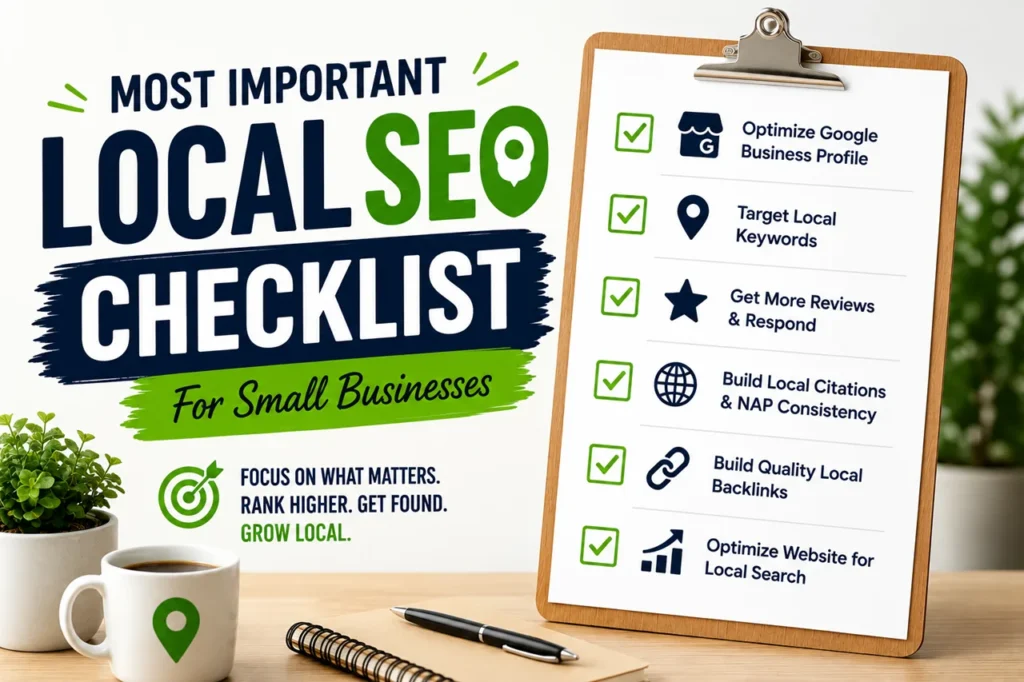
Google Business Profile Optimization Checklist
Many businesses create a profile but never fully optimize it.
This creates an opportunity for competitors.
Select the Right Categories
Primary categories significantly influence rankings.
Choose the most relevant category first.
Then add supporting categories.
For example:
Primary Category:
- Roofing Contractor
Secondary Categories:
- Gutter Service
- Siding Contractor
- Construction Company
Optimize Products and Services
List every service separately.
This increases keyword relevance and helps Google understand your business offerings.
Upload Photos Regularly
Businesses with active profiles often receive more engagement.
Upload:
- Exterior photos
- Interior photos
- Team photos
- Before-and-after photos
- Project photos
Publish Google Posts
Google Posts provide fresh content signals.
Post:
- Promotions
- Announcements
- New services
- Seasonal offers
- Events
Manage Questions and Answers
Monitor the Q&A section regularly.
Answer questions promptly and professionally.
This improves trust and customer experience.
Local SEO Audit Checklist
A local SEO audit identifies weaknesses that may hurt rankings.
Website Audit
Review:
- Speed
- Mobile usability
- Crawlability
- Metadata
- Internal links
- Schema markup
Google Business Profile Audit
Review:
- Categories
- Reviews
- Photos
- Business information
- Posts
- Services
Citation Audit
Check consistency across:
- Directories
- Social profiles
- Business listings
- Industry websites
Competitor Audit
Analyze:
- Reviews
- Backlinks
- Citations
- Content
- Categories
Understanding competitors often reveals easy opportunities.
Google Maps SEO Checklist
Google Maps visibility can drive significant leads.
Important Google Maps Ranking Factors
Major factors include:
- Google Business Profile completeness
- Reviews
- Keywords
- Proximity
- Citations
- Backlinks
- User engagement
Google Maps Optimization Best Practices
- Complete every profile section
- Encourage reviews
- Add fresh photos
- Build citations
- Improve website authority
- Generate local backlinks
Common Google Maps SEO Mistakes
Avoid:
- Fake reviews
- Keyword stuffing business names
- Incomplete profiles
- Duplicate listings
- Inconsistent contact information
Google increasingly penalizes manipulative practices.
Local Citations and NAP Consistency
NAP stands for:
- Name
- Address
- Phone Number
Consistency is critical.
Google uses citation data to verify business legitimacy.
What Are Local Citations?
A citation is any mention of your business information online.
Examples:
- Yelp
- Yellow Pages
- Chamber of Commerce websites
- Industry directories
- Local business listings
Why NAP Consistency Matters
If one directory shows a different phone number or address, Google may become less confident in your information.
Consistency improves trust and ranking potential.
Citation Building Checklist
- Major directories
- Industry directories
- Local directories
- Chamber websites
- Business associations
- Data aggregators
More importantly, ensure accuracy.
Not all citations carry equal value.
Local Link Building Strategies That Improve Local Rankings
Many small business owners focus only on Google Business Profile optimization and citations. While those elements are important, local link building remains one of the strongest ranking signals for both Google Maps SEO and local organic rankings.
A backlink is a link from another website to your business website. Google treats quality backlinks as votes of confidence.
The more trusted local websites that mention your business, the more authority your website can gain.
Why Local Link Building Matters
Local backlinks help Google understand:
- Your business serves a specific geographic area.
- Other organizations trust your business.
- Your company is active within the community.
- Your website deserves greater visibility.
A single backlink from a respected local news website can often be more valuable than dozens of low-quality directory links.
Best Local Link Building Opportunities
Local Business Partnerships
Partner with complementary businesses.
Examples include:
- Realtors partnering with home inspectors.
- Dentists partnering with orthodontists.
- Fitness centers partnering with nutritionists.
These relationships often create natural linking opportunities.
Local Chambers of Commerce
Most chambers provide member directories.
Benefits include:
- Local citations
- Trust signals
- Relevant backlinks
- Community visibility
Local Sponsorships
Sponsor:
- Charity events
- School programs
- Sports teams
- Community festivals
Many organizations acknowledge sponsors on their websites.
Local Media Coverage
Reach out to:
- Newspapers
- Community blogs
- Local magazines
- Industry publications
Interesting business stories often earn valuable media mentions.
Community Resource Pages
Many cities maintain business resource pages.
These pages often link to trusted local businesses.
Local Link Building Checklist
- Join local business organizations
- Sponsor community events
- Submit press releases
- Partner with local businesses
- Contribute expert quotes
- Create local resource guides
- Participate in local events
- Build relationships with local journalists.
Local Content Marketing Strategies
Content marketing is one of the most overlooked local SEO techniques.
Many businesses publish generic blog posts that could apply to any city.
Local content performs better because it connects directly with the target audience.
Why Local Content Matters
Google wants to serve relevant information.
When your content discusses local topics, neighborhoods, events, and community issues, it sends stronger geographic signals.
Local content also attracts:
- Local backlinks
- Local traffic
- Local engagement
- Local customers
Create Location-Specific Service Pages
Instead of creating one general service page, create targeted pages.
Example:
Instead of:
- Roofing Services
Create:
- Roofing Services in Dallas
- Roofing Services in Fort Worth
- Roofing Services in Plano
Each page should contain unique content.
Avoid duplicate location pages.
Publish Local Guides
Local guides perform exceptionally well.
Examples include:
- Best Neighborhoods in Austin for Families.
- Complete Homeowner Guide for Chicago Residents.
- Small Business Networking Events in Miami.
These guides provide value while supporting local SEO.
Share Customer Success Stories
Case studies build trust and improve conversions.
Include:
- Customer challenges
- Solutions provided
- Results achieved
- Geographic details
Real stories often outperform promotional content.
Local Content Ideas
- Community news
- Local event coverage
- Industry updates
- Neighborhood spotlights
- Seasonal tips
- Customer stories
- Local statistics
- Expert interviews
Online Reviews and Reputation Management
Reviews influence both rankings and purchasing decisions.
Research consistently shows that consumers trust online reviews almost as much as personal recommendations.
Why Reviews Matter
Reviews help:
- Increase visibility
- Improve trust
- Influence purchasing decisions
- Boost local rankings
Businesses with strong review profiles often outperform competitors.
Best Practices for Getting More Reviews
Ask customers immediately after a successful interaction.
Timing matters.
Happy customers are more likely to leave positive feedback when the experience is fresh.
Review Request Methods
- Email campaigns
- SMS requests
- QR codes
- Printed cards
- Follow-up calls
Make the process simple.
The fewer steps required, the higher the response rate.
Respond to Every Review
Whether positive or negative, every review deserves a response.
Benefits include:
- Better customer relationships
- Stronger trust signals
- Improved brand image
- Additional keyword relevance
Handling Negative Reviews
Stay professional.
Never argue publicly.
Instead:
- Acknowledge concerns
- Offer solutions
- Invite offline discussion
- Demonstrate professionalism
Potential customers often judge businesses based on how they respond to criticism.
Review Management Checklist
- Request reviews regularly
- Respond to all reviews
- Monitor review platforms
- Address negative feedback quickly
- Showcase testimonials
- Track review growth
Technical Local SEO Checklist
Technical SEO supports all other optimization efforts.
Without a technically sound website, rankings can suffer.
Mobile Optimization
Most local searches occur on mobile devices.
Your website should:
- Load quickly
- Display properly
- Have easy navigation
- Include click-to-call buttons
Improve Website Speed
Slow websites frustrate users.
Optimization areas include:
- Image compression
- Browser caching
- Code optimization
- Fast hosting
Local Business Schema Markup
Schema helps search engines understand your business.
Common schema types include:
- Local Business Schema
- Organization Schema
- Review Schema
- FAQ Schema
- Service Schema
Create and Submit XML Sitemaps
XML sitemaps help search engines discover important pages.
Submit your sitemap through Google Search Console.
Fix Technical Errors
Regularly monitor:
- Broken links
- Crawl errors
- Redirect chains
- Duplicate content
- Indexing issues
Google Business Profile Optimization vs Traditional SEO
| Factor | Google Business Profile SEO | Traditional SEO |
|---|---|---|
| Focus | Local Visibility | Organic Rankings |
| Platform | Google Maps | Search Results |
| Reviews Impact | Very High | Moderate |
| Citations | Important | Less Important |
| Backlinks | Important | Very Important |
| Location Signals | Critical | Moderate |
| Business Hours | Important | Not Relevant |
| NAP Consistency | Critical | Moderate |
Both strategies should work together for maximum visibility.
Local SEO Tools Worth Using
The right tools can save time and improve performance.
Free Local SEO Tools
| Tool | Purpose |
| Google Business Profile | Local Listings |
| Google Search Console | Performance Tracking |
| Google Analytics | Traffic Analysis |
| Google Keyword Planner | Keyword Research |
| Google Trends | Trend Analysis |
Paid Local SEO Tools
| Tool | Purpose |
| Semrush | SEO Research |
| Ahrefs | Backlink Analysis |
| BrightLocal | Local SEO Management |
| Whitespark | Citation Building |
| Moz Local | Listing Management |
What Tool Should Beginners Start With?
For most small businesses:
- Google Business Profile
- Google Search Console
- Google Analytics
- Semrush or Ahrefs
These tools cover most essential needs.
Common Local SEO Mistakes Small Businesses Make
Many businesses unknowingly damage their rankings.
Incomplete Google Business Profiles
Missing information reduces relevance and trust.
Inconsistent Business Information
Different addresses or phone numbers create confusion.
Ignoring Reviews
Reviews are one of the strongest local ranking factors.
Poor Mobile Experience
Mobile-first indexing makes mobile optimization essential.
Duplicate Listings
Duplicate profiles can split authority and confuse Google.
Thin Location Pages
Location pages need unique and useful content.
Avoid creating dozens of nearly identical pages.
Lack of Local Content
Without local content, Google receives fewer geographic signals.
Local SEO Checklist: Beginner vs Advanced Comparison
| Activity | Beginner | Advanced |
| Google Business Profile Setup | Yes | Yes |
| Local Keyword Research | Yes | Yes |
| Citation Building | Yes | Yes |
| Review Management | Yes | Yes |
| Local Content Creation | Basic | Extensive |
| Local Link Building | Basic | Advanced |
| Schema Markup | Optional | Required |
| Competitor Analysis | Limited | Comprehensive |
| Conversion Tracking | Basic | Advanced |
| Multi-Location Optimization | No | Yes |
Businesses can start with beginner strategies and gradually implement advanced tactics.
Measuring Local SEO Success
Without tracking, improvement becomes difficult.
Key Performance Indicators
Monitor:
- Google Maps rankings
- Local keyword rankings
- Website traffic
- Organic traffic
- Phone calls
- Form submissions
- Direction requests
- Review growth
- Conversion rates
Important Reports to Monitor
Google Search Console:
- Clicks
- Impressions
- CTR
- Average position
Google Business Profile Insights:
- Calls
- Website visits
- Direction requests
- Searches
Tracking these metrics helps identify what is working and where improvements are needed.
Creating a Winning Local SEO Strategy for Long-Term Growth
A Local SEO Checklist is valuable, but sustainable success comes from having a complete local SEO strategy.
Many businesses perform a one-time optimization and expect long-term results. Unfortunately, local search rankings are constantly changing. Competitors improve their websites, earn new reviews, build more backlinks, and publish fresh content.
To stay competitive, businesses must view local SEO as an ongoing process rather than a one-time project.
Step 1: Establish a Strong Foundation
Start by optimizing the essentials:
- Google Business Profile
- Website structure
- NAP consistency
- Local citations
- Mobile usability
Without a strong foundation, advanced tactics often deliver limited results.
Step 2: Build Authority
Authority is one of the biggest differences between businesses that rank and those that struggle.
Authority comes from:
- Quality backlinks
- Positive reviews
- Local mentions
- Community engagement
- Helpful content
The more signals of trust your business earns, the stronger your visibility becomes.
Step 3: Create Consistent Content
Content should not be published randomly.
Develop a content calendar focused on:
- Local search queries
- Community interests
- Customer questions
- Industry trends
Consistent publishing helps maintain relevance.
Step 4: Monitor and Improve
SEO is never finished.
Review performance monthly.
Track:
- Rankings
- Traffic
- Leads
- Reviews
- Conversions
Then identify opportunities for improvement.
Multi-Location SEO for Growing Businesses
Many businesses operate in multiple cities.
Examples include:
- Law firms
- Medical practices
- Home service companies
- Franchises
- Retail chains
These businesses require a specialized Multi Location SEO approach.
Challenges of Multi-Location SEO
Common challenges include:
- Duplicate content
- Location confusion
- Managing multiple listings
- Maintaining NAP consistency
- Review management
Best Practices for Multi-Location SEO
Create Unique Location Pages
Every location should have its own page.
Include:
- Address
- Phone number
- Directions
- Staff information
- Customer testimonials
- Service details
Avoid copying content from one location page to another.
Create Separate Google Business Profiles
Each physical location should have its own profile.
This improves local relevance and visibility.
Build Location-Specific Citations
Citations should match the information for each branch.
Consistency remains critical.
Example Structure
A law firm with offices in three cities could create:
- Personal Injury Lawyer Dallas
- Personal Injury Lawyer Houston
- Personal Injury Lawyer Austin
Each page targets a different geographic market.
Service Area Business SEO Best Practices
Not every business serves customers at a physical location.
Examples include:
- Plumbers
- Electricians
- HVAC contractors
- Landscapers
- Cleaning companies
These businesses operate as service area businesses.
How Service Area SEO Differs
Service area businesses must focus on geographic coverage rather than storefront visibility.
Google allows businesses to define service areas within their Google Business Profile.
Service Area SEO Checklist
- Define service areas correctly
- Create service-area landing pages
- Build citations consistently
- Generate reviews from different locations
- Publish local content
- Earn local backlinks
Landing Page Example
A roofing company serving five cities might create:
- Roofing Services in Dallas
- Roofing Services in Plano
- Roofing Services in Garland
- Roofing Services in Frisco
- Roofing Services in McKinney
Each page should contain unique content and localized information.
Local SEO Trends Shaping the Future
Local SEO continues to evolve.
Businesses that adapt early often gain a competitive advantage.
AI-Powered Search
Search engines increasingly use artificial intelligence to understand user intent.
This means businesses should focus on:
- Helpful content
- Comprehensive answers
- Clear expertise
- User experience
Voice Search Optimization
Many consumers now use voice assistants.
Examples include:
- “Find a dentist near me.”
- “Best coffee shop nearby.”
- “Emergency plumber open now.”
Voice searches tend to be conversational.
Create content that answers real questions naturally.
Visual Search
Photos and videos are becoming more important.
Businesses should:
- Upload high-quality photos
- Add geotagged images where appropriate
- Publish videos regularly
- Showcase completed projects
User Experience Signals
Google increasingly measures user satisfaction.
Factors include:
- Page speed
- Mobile usability
- Engagement
- Bounce rate
- Conversion behavior
Better user experiences often support better rankings.
Real-World Example: How Local SEO Helps Small Businesses Grow
Imagine two plumbing companies operating in the same city.
Company A
- Incomplete Google Business Profile
- Few reviews
- No local content
- Poor website speed
- Limited citations
Company B
- Fully optimized profile
- Consistent NAP information
- Hundreds of reviews
- Strong local backlinks
- Regular content publishing
Which company is more likely to rank?
In most cases, Company B.
The difference is not luck.
It is the result of following a structured Local SEO Checklist consistently.
This example highlights why local SEO can become one of the most profitable marketing channels available to small businesses.
Expert Opinion
After working with local businesses across multiple industries, one pattern becomes clear.
The businesses that achieve the best local rankings are rarely those with the largest budgets.
Instead, they are the businesses that consistently execute the fundamentals.
Many owners look for shortcuts.
They focus on tricks, hacks, and quick wins.
However, local SEO success usually comes from doing simple things exceptionally well:
- Optimizing Google Business Profile
- Collecting reviews consistently
- Maintaining NAP consistency
- Publishing valuable local content
- Building trusted local backlinks
Businesses that commit to these fundamentals often outperform larger competitors over time.
If you are a small business owner, focus on execution rather than chasing every new trend.
Consistency beats complexity.
Author Expertise & Trust Signals
This guide was created using established local search optimization principles, real-world local SEO experience, and industry best practices used by successful agencies and businesses.
The recommendations in this article are based on:
- Google Business Profile optimization practices
- Local ranking factor studies
- Citation management experience
- Website optimization strategies
- Review generation campaigns
- Local content marketing initiatives
- Technical SEO audits
- Small business growth case studies
Rather than relying on shortcuts or manipulative tactics, this guide emphasizes sustainable strategies that align with search engine guidelines and long-term business growth.
Readers should use this Local SEO Checklist as a practical framework and adapt it to their specific industry, market, and business goals.
Conclusion
Local SEO has become one of the most effective marketing channels available to small businesses.
Consumers increasingly rely on Google Search and Google Maps to find nearby products and services. Businesses that appear prominently in local search results gain more visibility, more website traffic, more phone calls, and ultimately more customers.
The good news is that local SEO does not require a massive budget. Most businesses can achieve meaningful improvements simply by optimizing their Google Business Profile, maintaining accurate business information, generating customer reviews, building local citations, creating valuable content, and earning trusted backlinks.
This Local SEO Checklist provides a complete roadmap for improving local search visibility. Whether you are a beginner building your first Google Business Profile or an established business looking to strengthen your local presence, the principles remain the same.
Focus on helping customers, maintain consistency, monitor performance, and continue improving over time.
Businesses that treat local SEO as a long-term investment often see lasting growth and stronger competitive advantages within their local markets.
FAQs
What is a Local SEO Checklist?
A Local SEO Checklist is a step-by-step framework that helps businesses optimize their online presence for local search results, Google Maps visibility, and local customer acquisition.
How important is Google Business Profile for local SEO?
Google Business Profile is one of the most important local ranking factors. A fully optimized profile can significantly improve Google Maps visibility and local search rankings.
How long does local SEO take to show results?
Most businesses begin seeing measurable improvements within three to six months, although timelines vary depending on competition, industry, and current optimization levels.
What are local citations?
Local citations are online mentions of a business’s name, address, and phone number on directories, websites, and business listings.
How do reviews affect local rankings?
Reviews influence trust, credibility, and local ranking signals. Businesses with more positive reviews often achieve better visibility in local search results.
What is NAP consistency?
NAP consistency means keeping your business name, address, and phone number identical across all websites, directories, and listings.
Do small businesses really need local SEO?
Yes. Local SEO helps small businesses compete effectively, attract nearby customers, increase leads, and improve visibility in local search results.
Which local SEO activity should I prioritize first?
Start with Google Business Profile optimization. It provides one of the fastest and most impactful improvements for local visibility, Google Maps rankings, and customer engagement.
Can local SEO help businesses without a physical storefront?
Yes. Service area businesses such as plumbers, electricians, HVAC contractors, landscapers, and cleaning companies can benefit greatly from local SEO. By optimizing their Google Business Profile, defining service areas, creating location-specific landing pages, and building local citations, they can attract customers throughout their target regions.
What are the best local SEO tools for small businesses?
Some of the best local SEO tools include Google Business Profile, Google Search Console, Google Analytics, Semrush, Ahrefs, BrightLocal, Whitespark, and Moz Local. These tools help with keyword research, citation management, rank tracking, backlink analysis, performance monitoring, and local SEO audits.
If you are working through this checklist on WordPress, an SEO plugin makes most of these steps far quicker. I use Rank Math — see my Rank Math SEO plugin review.