
The best VPS hosting depends on one question first: do you want to run the server yourself, or pay someone to run it for you? For a cheap self-managed VPS, Hostinger’s KVM plans are my top pick, from $6.49 a month on a 24-month term with 4 GB of RAM. If you would rather pay by the hour with no contract, Vultr, DigitalOcean and Akamai’s Linode bill that way (so does Hetzner, but every Hetzner Cloud server was marked unavailable when I checked). If you don’t want to manage a Linux server, look at ScalaHosting’s managed VPS or Cloudways.
Below are all 15 providers in my ranking order, with the plan, price, CPU type and the catch for each, checked on their official pages and price catalogues on 28 October 2026.
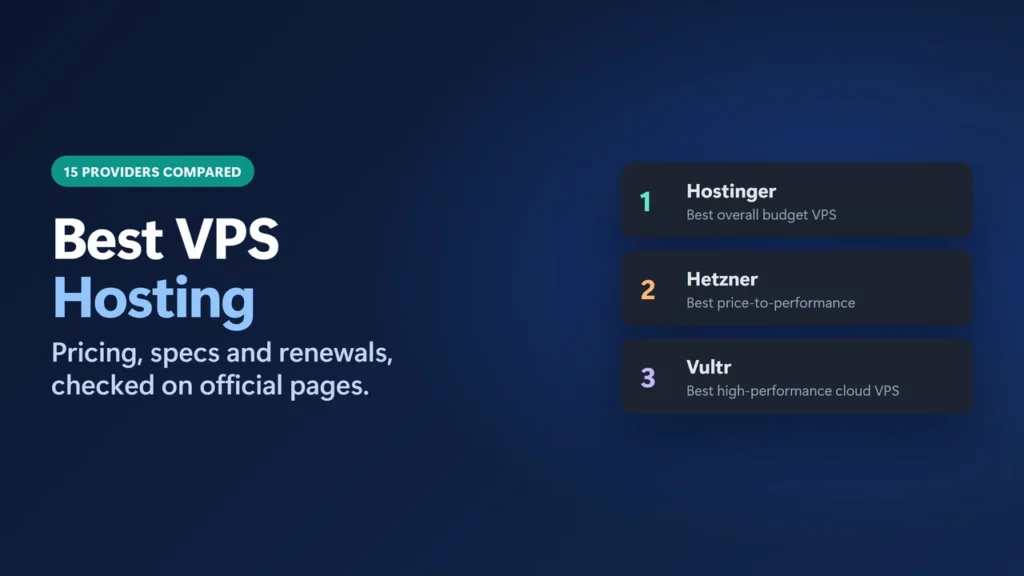
How I compared them: this site runs on Hostinger’s web hosting (not its VPS), and I’ve used DigitalOcean. I have not run speed or uptime tests on these 15 VPS plans; the one thing I measured myself is network latency from my connection in India to the official test endpoints that 9 of the 15 providers publish (method below). Otherwise this list compares what each provider publishes: price, renewal, billing term, CPU type, RAM, storage, management and terms. Prices were read logged out on 28 October 2026 on each provider’s official pages or its own public price catalogue, in US dollars except Hetzner and UpCloud, whose pages showed euros by default (both have a currency switch; I did not record their dollar prices). Several are Black Friday or introductory prices that will change. The order is my editorial ranking for a typical small project. Some links are affiliate links (Hostinger, Cloudways and InMotion): I may earn a commission if you buy through them, at no extra cost to you, and it does not change the order.
Key takeaways
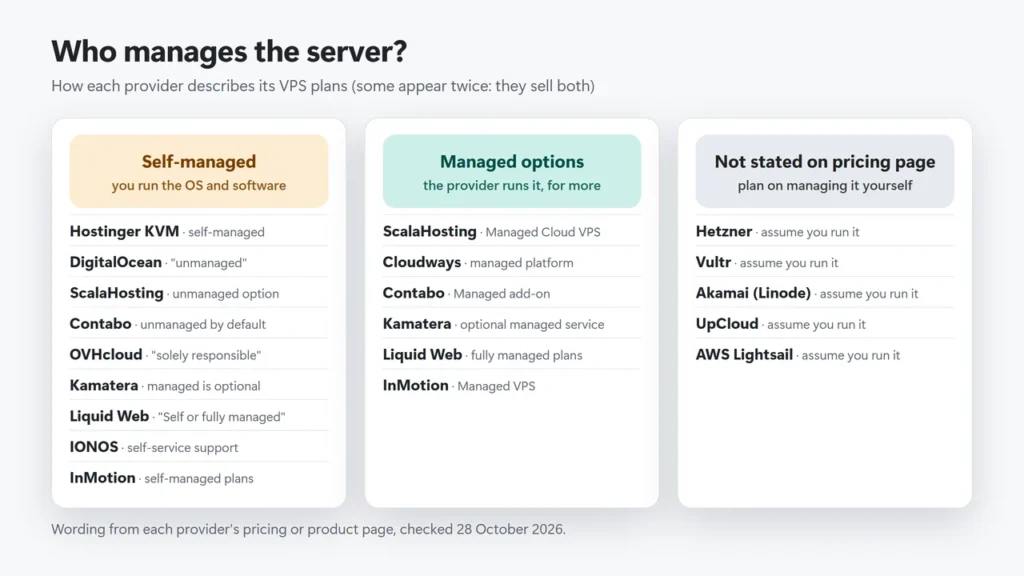
- Decide between self-managed and managed first: a self-managed VPS is cheaper, but updates, security and backups are your job.
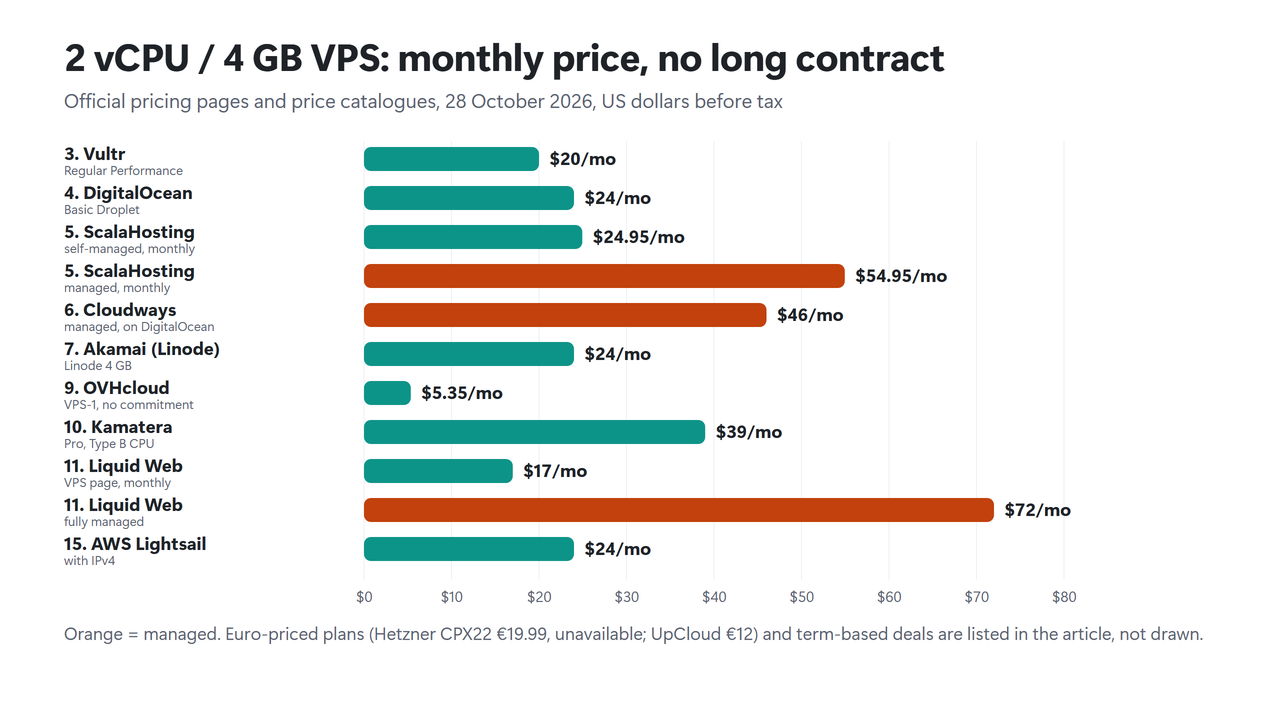
- Compare like for like: for a 2 vCPU / 4 GB server with no long contract, the prices I read on 28 October 2026 ran from $5.35 a month (OVHcloud, self-managed) to $72 (Liquid Web, fully managed).
- Read the term and the renewal line: Hostinger, InMotion and ScalaHosting show intro prices for 12 or 24 months, then renew higher.
- Check whether vCPUs are shared or dedicated: Hetzner, Vultr and Linode say their entry plans share CPU, DigitalOcean’s Basic Droplets and Lightsail are built for bursty use, InMotion and ScalaHosting promise guaranteed vCPU cores, and the rest don’t say clearly.
- When I checked, every Hetzner Cloud server on its pricing pages was marked “currently unavailable”.
Table of Contents
- 1Best VPS Hosting Providers at a Glance
- 2The 15 Best VPS Hosting Providers
- 1. Hostinger: best overall budget VPS hosting
- 2. Hetzner: best price-to-performance
- 3. Vultr: best high-performance cloud VPS
- 4. DigitalOcean: best for developers and scalability
- 5. ScalaHosting: best managed VPS hosting
- 6. Cloudways: best managed WordPress cloud hosting
- 7. Akamai Cloud (Linode): best developer-friendly infrastructure
- 8. Contabo: best affordable high-resource VPS
- 9. OVHcloud: best for network infrastructure and DDoS protection
- 10. Kamatera: best customizable cloud VPS
- 11. Liquid Web: best premium managed VPS
- 12. IONOS: best low-cost entry-level VPS
- 13. InMotion Hosting: best business VPS hosting
- 14. UpCloud: best performance-focused cloud VPS
- 15. AWS Lightsail: best for AWS ecosystem integration
- 3Price Comparison: The Same 2 vCPU / 4 GB Server
- 4How to Choose a VPS
- 1. Managed or self-managed
- 2. Shared or dedicated vCPU
- 3. Term, renewal and extras
- 4. Location, uptime and refunds
- 5Network Latency From My Connection in India (Measured)
- 6How I Ranked These VPS Providers
- 7Common Mistakes When Buying a VPS
- 8Frequently Asked Questions
- What is the best VPS hosting provider?
- What is the cheapest VPS hosting?
- What is the difference between managed and unmanaged VPS?
- Do VPS plans include backups?
- Is a VPS faster than shared hosting?
- Can I host WordPress on a VPS?
Best VPS Hosting Providers at a Glance
| Rank | Provider | Best for |
|---|---|---|
| 1 | Hostinger | Best overall budget VPS hosting |
| 2 | Hetzner | Best price-to-performance |
| 3 | Vultr | Best high-performance cloud VPS |
| 4 | DigitalOcean | Best for developers and scalability |
| 5 | ScalaHosting | Best managed VPS hosting |
| 6 | Cloudways | Best managed WordPress cloud hosting |
| 7 | Akamai Cloud (Linode) | Best developer-friendly infrastructure |
| 8 | Contabo | Best affordable high-resource VPS |
| 9 | OVHcloud | Best for network infrastructure and DDoS protection |
| 10 | Kamatera | Best customizable cloud VPS |
| 11 | Liquid Web | Best premium managed VPS |
| 12 | IONOS | Best low-cost entry-level VPS |
| 13 | InMotion Hosting | Best business VPS hosting |
| 14 | UpCloud | Best performance-focused cloud VPS |
| 15 | AWS Lightsail | Best for AWS ecosystem integration |
The 15 Best VPS Hosting Providers
1. Hostinger: best overall budget VPS hosting
| Hostinger | |
|---|---|
| Entry plan | KVM 1: 1 vCPU, 4 GB RAM, 50 GB NVMe, 4 TB bandwidth |
| Price | $6.49/mo for 24 months ($155.76 upfront), renews at $11.99/mo |
| 2 vCPU plan | KVM 2: 2 vCPU, 8 GB RAM, 100 GB NVMe, $8.79/mo for 24 months, renews at $14.99/mo |
| Management | Self-managed, with full root access |
| Included | Dedicated IP, free weekly backups, firewall management, Wanguard DDoS filtering |
On its 24-month deal, Hostinger’s entry KVM plan gives 4 GB of RAM for $6.49 a month ($11.99 on renewal), while Vultr, Linode and DigitalOcean give 1 GB for $5 to $6 a month with no contract. You get full root access, a dedicated IP and free weekly backups, and you can pick control panels such as cPanel, CyberPanel, Plesk or CloudPanel when you set the server up (I didn’t check licence costs). Hostinger says it has 10 data centers across 4 continents and offers a 30-day money-back guarantee. My Hostinger review covers its web hosting, which this site runs on. The button below is an affiliate link and opens Hostinger’s VPS hosting page.
Watch out: the price is for a 24-month term paid upfront, during Hostinger’s Black Friday sale; I found no end date on the page. KVM 1 renews at $11.99 a month. It is self-managed: Hostinger runs the hardware, and the operating system and software are your job. My Black Friday VPS hosting deals page tracks this sale and other VPS offers.
2. Hetzner: best price-to-performance
| Hetzner | |
|---|---|
| Entry plan | CPX02: 1 AMD vCPU, 1 GB RAM, 20 GB NVMe, 20 TB traffic in the EU |
| Price | €6.49/mo, excl. VAT (billed hourly up to a monthly cap) |
| 2 vCPU plan | CPX22: 2 vCPU, 4 GB RAM, 80 GB NVMe, €19.99/mo excl. VAT |
| CPU | Shared (“based on shared resources”); dedicated vCPUs from €43.49/mo |
| Included | IPv4, firewalls, DDoS protection; backups cost extra |
Hetzner’s own site calls Hetzner Cloud “the winner in terms of price-performance ratio”, citing benchmark data from sparecores.com (I haven’t checked that analysis). Its EU plans include 20 TB of traffic, and IPv4, firewalls and DDoS protection are included. Locations are in Germany, Finland, the US and Singapore, and the cloud SLA is 99.9%.
Watch out: on 28 October 2026, every Hetzner Cloud server on its pricing pages showed “This product is currently unavailable. Please check back later.” to me as a logged-out visitor, and the Cost-Optimized line said “Currently not available”. Check availability before you plan around it. Prices are in euros, excluding VAT, and US and Singapore plans include much less traffic (1 TB and 0.5–1 TB).
3. Vultr: best high-performance cloud VPS
| Vultr | |
|---|---|
| Entry plan | Regular Performance: 1 vCPU, 1 GB RAM, 25 GB SSD, 1 TB bandwidth |
| Price | $5/mo ($0.007/hr) |
| 2 vCPU plan | 2 vCPU, 4 GB RAM, 80 GB SSD, 3 TB, $20/mo |
| CPU | Shared vCPUs; High Performance and High Frequency plans use newer CPUs and NVMe |
| SLA | “100% uptime guarantee” based on network and host node availability |
Vultr’s Cloud Compute plans “run atop shared vCPUs”, and its cheapest Regular Performance line uses previous-generation Intel CPUs and regular SSDs. For performance, Vultr points you to its High Performance and High Frequency plans, built on newer AMD or Intel CPUs with NVMe storage. Its public API lists 33 regions, and billing is hourly.
Watch out: the $5 plan is the older hardware tier, so compare the High Performance prices if speed is why you’re choosing Vultr. Backups add 20% to the server price, DDoS protection is something you switch on, and you are billed for a server while it exists, even when it is stopped.
4. DigitalOcean: best for developers and scalability
| DigitalOcean | |
|---|---|
| Entry plan | Basic Droplet: 1 vCPU, 512 MiB RAM, 10 GiB SSD, 500 GiB transfer |
| Price | $4/mo; 1 GiB plan $6/mo |
| 2 vCPU plan | 2 vCPU, 4 GiB RAM, $24/mo |
| Management | “core Droplet offering is unmanaged” |
| SLA | 99.99% monthly uptime per Droplet |
Apart from Hostinger, whose web hosting (not VPS) runs this site, DigitalOcean is the only provider on this list I’ve used myself. Droplets are billed per second with a monthly cap, so you can create a server for a test and delete it the same day. Basic Droplets suit “bursty applications that can handle variable levels of CPU”, and DDoS protection is included at no cost. My DigitalOcean review goes into the platform in more detail.
Watch out: it does not offer refunds (“We do not offer refunds”), backups cost 20% (weekly) or 30% (daily) of the Droplet price, and transfer beyond your allowance is billed at $0.01 per GiB.
5. ScalaHosting: best managed VPS hosting
| ScalaHosting | |
|---|---|
| Managed plan | Build #1: 2 CPU cores, 4 GB RAM, 50 GB NVMe |
| Price | $22.46/mo for 12 months (Black Friday), renews at $54.95/mo |
| Unmanaged plan | 2 cores, 4 GB, 50 GB NVMe: $19.95/mo for 12 months, renews at $24.95/mo |
| Control panel | SPanel included; cPanel is an add-on listed at $32.95 for 5 accounts (billing period not stated) |
| Refund | “Anytime” money-back: full refund within 30 days, prorated after (new clients) |
ScalaHosting is the best fit here if you want a VPS someone else runs: its Managed Cloud VPS team “is responsible for setting up your server, monitoring hardware, installing software, maintenance, and issue resolution”, and the plans come with SPanel, its own control panel, so you don’t pay for a cPanel licence unless you want one. It runs its own servers in Seattle, Dallas, New York and Sofia, and also offers AWS and other cloud locations. My ScalaHosting review covers SPanel and the plans in depth.
Watch out: the managed plan’s renewal is more than double the Black Friday price ($22.46 to $54.95 a month; $54.95 is also the monthly-billing price), and add-ons such as longer backup retention and monitoring cost extra. The plan page quotes 99.99% uptime, while its terms’ credit table starts at 99.9%.
6. Cloudways: best managed WordPress cloud hosting
| Cloudways | |
|---|---|
| Entry plan | DigitalOcean Standard: 1 vCPU, 1 GB RAM, 25 GB SSD, 1 TB |
| Price | $11/mo, billed hourly ($0.0164/hr) |
| 2 vCPU plan | 2 vCPU, 4 GB RAM, 80 GB SSD, 4 TB: $46/mo |
| Management | Managed platform on DigitalOcean, Vultr, Linode, AWS or Google Cloud |
| Included | Unlimited websites; Cloudflare Enterprise from $4.99/domain/mo; Malware Protection from $4/app/month |
Cloudways sits between a VPS and managed hosting: it puts your sites on a cloud server from DigitalOcean, Vultr, Linode, AWS or Google Cloud and manages that server for you, so you get a cloud server without running Linux yourself. Billing is hourly, with no long contract. My Cloudways review explains the trade-offs. The button below is an affiliate link and opens Cloudways’ sign-up page.
Watch out: the same 2 vCPU / 4 GB DigitalOcean server costs $24 a month direct from DigitalOcean and $46 through Cloudways, so the management costs about $22 a month on that size. Premium (NVMe) servers cost more ($54 for the same size), and add-ons are extra.
7. Akamai Cloud (Linode): best developer-friendly infrastructure
| Akamai Cloud (Linode) | |
|---|---|
| Entry plan | Nanode 1 GB: 1 CPU, 1 GB RAM, 25 GB, 1 TB transfer |
| Price | $5/mo ($0.0075/hr) in North America |
| 2 vCPU plan | Linode 4 GB: 2 CPUs, 4 GB RAM, 80 GB, 4 TB, $24/mo |
| CPU | Shared CPU (“CPU resources are shared with other Linodes”) |
| Backups | $2/mo on the Nanode, $5/mo on the 4 GB plan |
Linode is now Akamai Cloud (linode.com redirects to Akamai’s pricing). The plans are a straightforward developer VPS: hourly billing, a public API and transfer included, 4 TB on the 4 GB plan. Akamai’s API lists 33 core regions.
Watch out: prices differ by region (the Nanode is $6 in Jakarta and $7 in São Paulo), and I could not verify its uptime SLA, because its SLA page blocked automated reading and I did not find it on the pricing page.
8. Contabo: best affordable high-resource VPS
| Contabo | |
|---|---|
| Entry plan | Cloud VPS 4: 4 vCPU, 8 GB RAM, 100 GB SSD, 200 Mbit/s port, unlimited traffic |
| Price | $6.60/mo on its US catalogue (monthly); the page showed €4.40/mo for the first 24 months |
| Management | Unmanaged by default; a Managed add-on is listed at $144.99 (billing period not stated) |
| Included | Free firewall and DDoS protection, IPv4 and IPv6, 1 snapshot |
| Extras | Auto Backup listed at $2 (billing period not stated); US locations +$1.30 to +$1.90/mo; Asia/Australia more |
Contabo’s entry plan ties InMotion’s for the most vCPU and RAM among the entry plans here (4 vCPU and 8 GB), but costs $6.60 a month with no long contract against InMotion’s $13.99 on a 24-month term, about the price of a 1 GB plan at Vultr, Linode or DigitalOcean. Traffic is unlimited under a fair-use policy, and DDoS protection and a firewall are included.
Watch out: the port speed is 200 Mbit/s, the CPU type (shared or dedicated) isn’t stated, the price after the first 24 months isn’t stated, the contract renews for the same length as the first term, and locations outside the EU cost extra. The “99.9% Uptime” claim is marketing; I found no SLA document.
9. OVHcloud: best for network infrastructure and DDoS protection
| OVHcloud | |
|---|---|
| Entry plan | VPS-1: 2 vCores, 4 GB RAM, 40 GB NVMe, 500 Mbps, unlimited traffic |
| Price | $4.54/mo with a 12-month commitment; $5.35/mo with no commitment |
| Management | “solely responsible for configuring and maintaining the server” |
| Included | Anti-DDoS protection, daily backup of the previous 24 hours, $0 installation |
| SLA | 99.9% |
Every OVHcloud VPS includes anti-DDoS protection: “Mitigation is automatic, with no impact on your services.” Its entry VPS is the cheapest 2 vCore / 4 GB plan in this comparison among plans with no commitment, and a daily backup is included.
Watch out: VPSs in Mumbai, Singapore and Sydney have a 1 TB monthly traffic quota on VPS-1, after which bandwidth drops to 10 Mbps. On OVHcloud’s US site, VPSs ordered outside US regions “will not be able to be modified or upgraded after delivery”, and downgrading means ordering a new plan and moving your data. Prices exclude tax, and I found no refund or trial terms.
10. Kamatera: best customizable cloud VPS
| Kamatera | |
|---|---|
| Entry plan | Basic: 1 vCPU (Type A), 1 GB RAM, 20 GB NVMe, 5 TB traffic |
| Price | $4/mo, hourly or monthly billing, no long-term contract |
| 2 vCPU plan | Pro: 2 vCPU (Type B), 4 GB RAM, 20 GB NVMe, $39/mo |
| Free trial | 30 days, services worth up to $100 on one server; credit card required |
| SLA | 99.9% |
Kamatera lets you build a server from parts: CPU type (Availability, General Purpose, Dedicated or Burstable), cores, RAM, storage and location, instead of picking from fixed sizes. Type B is described as a dedicated CPU thread “so fewer fluctuations under load”. Its 30-day trial gives you up to $100 of services on one server.
Watch out: the Pro plan’s 20 GB disk is small for $39 a month, the description of the cheap Type A CPU contradicts itself on Kamatera’s own page, traffic beyond your allowance costs $0.01 per GB, and in Kamatera’s calculator, servers in Asia and Sydney come with 1,000 GB of traffic rather than 5 TB.
11. Liquid Web: best premium managed VPS
| Liquid Web | |
|---|---|
| Entry plan | 1 vCPU, 2 GB RAM, 60 GB SSD, 2 TB bandwidth |
| Price | $11/mo, billed monthly |
| 2 vCPU plan | 2 vCPU, 4 GB RAM, 80 GB SSD: $17/mo on its VPS page (card says “Self or fully managed”); $72/mo on its fully managed page |
| Control panels | InterWorx, cPanel and Plesk available |
| Refund | Its terms say “all Fees are non-refundable” |
Liquid Web is the premium choice for a fully managed VPS: its managed plans include DDoS protection, firewalls and Acronis backup storage, and its team helps with restores. Plans are billed monthly. My Liquid Web review covers the managed plans.
Watch out: its fully managed page charges $72 a month for the same 2 vCPU / 4 GB spec its VPS page lists at $17 (that card says “Self or fully managed”, so check what the $17 covers before you order), fees are non-refundable, and its pages quote 99.99% uptime in one place and 99.9% in another.
12. IONOS: best low-cost entry-level VPS
| IONOS | |
|---|---|
| Entry plan | VPS S+: 1 vCore, 2 GB RAM, 60 GB NVMe, unlimited traffic at 1 Gbps |
| Price | $2/mo for 3 months on a 1-year term (struck-through price $6/mo) |
| 2 vCore plan | VPS M+: 2 vCores, 4 GB RAM, 120 GB NVMe, $5/mo for 3 months (struck-through $14) |
| Refund | 30-day money-back guarantee |
| Locations | United States, United Kingdom, Germany, Spain |
IONOS has the lowest headline price here, $2 a month, but only for the first 3 months of a 1-year term; if months four to twelve are billed at the struck-through $6, the first year costs $60, about $5 a month (my calculation; the page doesn’t say “renews at”). Traffic is unlimited, with a 30-day money-back guarantee if it doesn’t suit you. Its VPS+ servers run on AMD and Intel CPUs with NVMe storage.
Watch out: the $2 price lasts only 3 months and needs a 1-year term; the page shows $6 as the struck-through price but doesn’t say “renews at”, so confirm the price from month four at checkout. Whether the vCore is shared or dedicated isn’t stated.
13. InMotion Hosting: best business VPS hosting
| InMotion Hosting | |
|---|---|
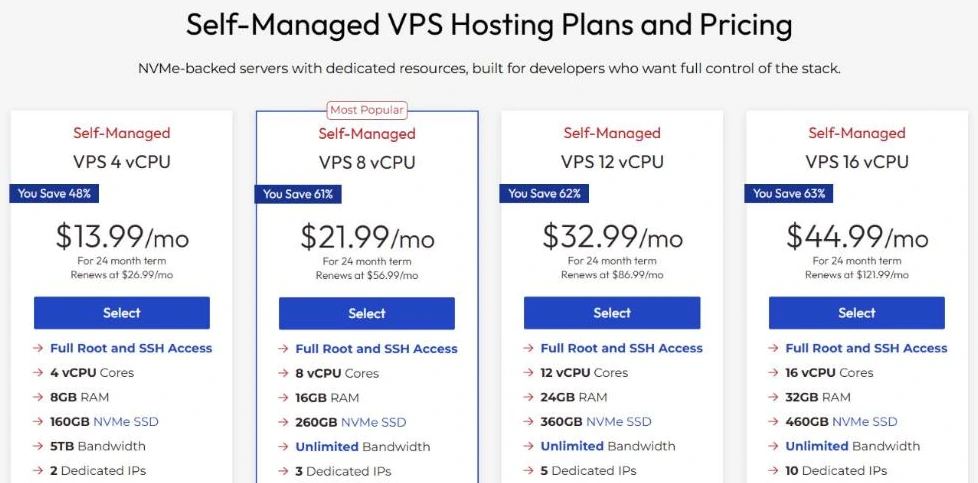
| Entry plan | VPS 4 vCPU: 4 vCPU, 8 GB RAM, 160 GB NVMe, 5 TB bandwidth, 2 dedicated IPs |
| Price | $13.99/mo for 24 months, renews at $26.99/mo |
| CPU | “Guaranteed vCPU and RAM, not shared or burstable” |
| Management | Self-managed; Managed VPS includes cPanel/WHM, patching and daily backups |
| Refund | 90-day money-back on 6-month or longer terms; 30 days on monthly |
InMotion’s VPS plans run in Los Angeles, Ashburn and Amsterdam, every self-managed plan includes on-demand snapshots and always-on DDoS protection, and its entry plan promises “Guaranteed vCPU and RAM, not shared or burstable”. It guarantees 99.99% uptime.
Watch out: the intro price is for 24 months and nearly doubles at renewal, and the self-managed plans come with no control panel (cPanel and WHM or Control Web Panel cost extra each month); free migration is listed for its Managed VPS. My InMotion Hosting review covers its other plans. The button below is an affiliate link and opens InMotion’s shared hosting page, not the VPS page.
Here is InMotion’s self-managed VPS table on 28 October 2026, with the renewal line under each price:
14. UpCloud: best performance-focused cloud VPS
| UpCloud | |
|---|---|
| Entry plan | Starter: 1 core, 1 GB RAM, 10 GB SSD, 250 Mbit/s |
| Price | €3/mo, billed by the hour, excl. local taxes |
| 2-core plan | Starter: 2 cores, 4 GB RAM, 30 GB, 500 Mbit/s, €12/mo |
| SLA | 99.99% on Starter; 99.999% on Premium plans |
| Trial | 7-day free trial; 30-day money-back on the first payment, up to €500/$500 |
UpCloud’s pitch is performance and reliability: its Premium plans carry a 99.999% SLA, and even the budget Starter plans include IPv4 and zero-cost egress under a fair transfer policy. Starter plans are billed by the hour, to a maximum of 28 days a month.
Watch out: Starter plans use previous-generation AMD CPUs and standard SSD storage, so the performance-focused hardware is in the Premium line, which I did not price. The 1 GB Starter plan is limited to 5 servers per customer, and port 25 (SMTP) is blocked by default.
15. AWS Lightsail: best for AWS ecosystem integration
| AWS Lightsail | |
|---|---|
| Entry plan | 0.5 GB RAM, 2 vCPUs (burstable), 20 GB SSD, 1 TB transfer, with IPv4 |
| Price | $5/mo, billed hourly up to that cap; $3.50/mo for an IPv6-only server |
| 2 vCPU plan | 4 GB RAM, 2 vCPUs, 80 GB SSD, 4 TB, $24/mo |
| CPU | Burstable: a baseline level of CPU with the ability to burst above it |
| SLA | Service credits start below 99.5% monthly uptime |
Lightsail is Amazon’s simple VPS: fixed monthly bundles inside your AWS account. New AWS accounts can get up to $200 in credits within 6 months, under AWS’s free-plan terms.
Watch out: the CPU is burstable (AWS describes “a baseline level of CPU performance with the additional ability to burst above the baseline”), so it suits uneven rather than constant heavy load; transfer overage starts at $0.09 per GB, far more than DigitalOcean’s $0.01; stopped instances are still billed; and if you start on AWS’s free plan, AWS suspends the account when the plan expires and keeps the data for 90 days.
Price Comparison: The Same 2 vCPU / 4 GB Server
Entry prices aren’t comparable because the plans are different sizes. Here is the closest thing to a fair comparison: what each provider charged for about 2 vCPU and 4 GB of RAM, billed hourly or monthly with no long contract, on 28 October 2026.
| Provider (rank) | 2 vCPU / 4 GB plan | Monthly price (no long term) |
|---|---|---|
| 3. Vultr | Regular Performance, 80 GB SSD, 3 TB | $20 |
| 4. DigitalOcean | Basic Droplet | $24 |
| 5. ScalaHosting (self-managed) | Config #1, 50 GB NVMe, monthly billing | $24.95 |
| 5. ScalaHosting (managed) | Build #1, 50 GB NVMe, monthly billing | $54.95 |
| 6. Cloudways (managed) | DigitalOcean Standard, 80 GB | $46 |
| 7. Akamai (Linode) | Linode 4 GB, 80 GB, 4 TB | $24 |
| 9. OVHcloud | VPS-1, 40 GB NVMe | $5.35 |
| 10. Kamatera | Pro, Type B, 20 GB NVMe | $39 |
| 11. Liquid Web (VPS page) | 80 GB SSD, 3 TB, “Self or fully managed” card | $17 |
| 11. Liquid Web (fully managed) | 80 GB SSD, 3 TB | $72 |
| 15. AWS Lightsail | 80 GB SSD, 4 TB, IPv4 | $24 |
The plans that need a commitment are cheaper per month but not like for like: Hostinger KVM 2 (2 vCPU, 8 GB) is $8.79 a month for 24 months, then $14.99; ScalaHosting’s unmanaged 2-core / 4 GB plan is $19.95 for 12 months, then $24.95 ($24.95 from the start on monthly billing); IONOS VPS M+ is $5 a month for 3 months on a 1-year term; and InMotion’s smallest plan is 4 vCPU and 8 GB at $13.99 for 24 months, then $26.99. Contabo’s Cloud VPS line has no plan this small: its smallest is 4 vCPU and 8 GB. My guide to hosting renewal prices shows how to work out the real cost over a whole term.
How to Choose a VPS
1. Managed or self-managed
A self-managed VPS is cheaper, but you install updates, configure the firewall, set up backups and fix whatever breaks. DigitalOcean puts it plainly: its core Droplet offering “is unmanaged, which means you are responsible for managing the server.” If that sounds like a burden, pay for management (ScalaHosting, Cloudways, Liquid Web or InMotion’s managed VPS). If you are not sure you need a VPS at all, my guide to shared vs VPS vs cloud hosting explains the difference and the signs you have outgrown shared hosting.
2. Shared or dedicated vCPU
Several entry plans say they share CPU: Vultr’s Cloud Compute runs “atop shared vCPUs”, Hetzner’s Regular Performance line is “based on shared resources”, Linode’s shared plans say “CPU resources are shared with other Linodes”, and DigitalOcean’s Basic Droplets and Lightsail are built for bursty use. InMotion and ScalaHosting promise guaranteed vCPU cores; the others don’t say clearly. That is fine for a website with ordinary traffic. For steady heavy load, look at dedicated-CPU plans (InMotion’s entry plan, Kamatera’s Type B, Hetzner’s General Purpose, DigitalOcean’s General Purpose Droplets and Linode’s dedicated plans).
3. Term, renewal and extras
Hourly providers (Vultr, DigitalOcean, Linode, Hetzner, UpCloud, Kamatera, Lightsail, Cloudways) let you stop paying any time. Hosts with long-term deals (Hostinger, InMotion, ScalaHosting, IONOS) look cheaper per month, but the advertised price needs a 12- to 24-month commitment (a 1-year term at IONOS), and the price rises afterwards (IONOS shows a higher struck-through price rather than a “renews at” line). Add the extras before you compare: backups (often 20% of the server price), a cPanel licence, extra IPv4 addresses and transfer overage.
4. Location, uptime and refunds
Pick a data center close to your visitors. Published uptime commitments ranged from Vultr’s 100% and UpCloud Premium’s 99.999% to 99.9% at Hetzner, OVHcloud and Kamatera; Lightsail’s credits start below 99.5%. Refund terms vary even more: ScalaHosting refunds unused time “anytime” (in full within 30 days, new clients only), InMotion gives 90 days on 6-month or longer terms, and DigitalOcean and Liquid Web don’t refund. Kamatera (30 days) and UpCloud (7 days) offer free trials.
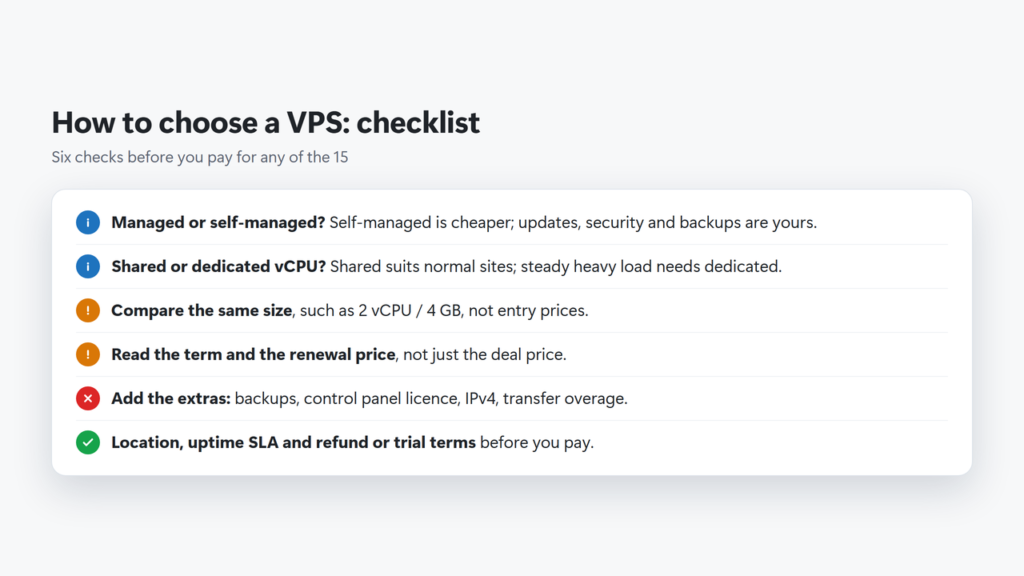
The checklist in text: decide whether you will manage the server yourself; check whether the vCPUs are shared or dedicated; compare plans of the same size (about 2 vCPU and 4 GB for a busy website); read the term and the renewal price, not just the deal price; add backups, a control panel licence, IPv4 and transfer overage to the monthly cost; choose a location near your visitors; check the uptime SLA; and check the refund or trial terms before you pay.
Network Latency From My Connection in India (Measured)
Where a provider publishes an official speed-test, looking-glass or reachability endpoint, I timed it from my own internet connection in India on 28 October 2026 (17:08 to 17:13 IST). I used the location nearest India that each provider documents, took 5 samples with curl, and report the median TCP connect time, which is roughly one network round trip. Only small pages were fetched, no large test files.
| Provider (rank) | Test endpoint location | Median round trip |
|---|---|---|
| 2. Hetzner | Singapore | 73.1 ms |
| 3. Vultr | Mumbai | 14.2 ms |
| 7. Akamai (Linode) | Mumbai, then Singapore | Both documented endpoints failed (0/5) |
| 8. Contabo | Singapore | 70.0 ms |
| 9. OVHcloud | Mumbai | 17.2 ms |
| 10. Kamatera | Singapore | 67.7 ms |
| 11. Liquid Web | Amsterdam (nearest it documents) | 138.9 ms |
| 14. UpCloud | Singapore | 70.5 ms |
| 15. AWS (EC2 test address; Lightsail also has a Mumbai region) | Mumbai (ap-south-1) | 13.4 ms |
What this does and doesn’t tell you. It shows network distance: the Mumbai test endpoints (AWS, Vultr and OVHcloud) answered in about 13 to 17 ms, the Singapore ones in about 68 to 73 ms, and Liquid Web’s Amsterdam one in about 139 ms. Akamai’s two documented test hosts didn’t answer at all, which looks like retired test servers, not a fact about Linode’s network. If your visitors are in India, a location in India or nearby cuts that delay on every request. It is one connection, measured once in the evening, so your figures will differ by city, ISP, time of day and country. It says nothing about CPU, disk or server speed, and a test endpoint may sit on a different network from customer servers. It did not change the ranking.
How I Ranked These VPS Providers
The order is my editorial judgement for a typical small project, such as a busy WordPress site or a small app, weighing the total price over the term including renewal, how much you get for it, who manages the server, the CPU type, and the terms (refunds, SLA, contract length). It is not a benchmark: I have not run speed or uptime tests on these plans, and the latency figures above did not change the order. Every price and specification comes from the provider’s own pricing page, product page, documentation, terms or public price catalogue/API, read on 28 October 2026. If you are choosing between cloud platforms more broadly, my best cloud hosting providers list covers managed cloud hosts in more depth.
Common Mistakes When Buying a VPS
| Mistake | Why it costs you | What to do |
|---|---|---|
| Comparing entry prices of different sizes | A $4 plan with 512 MB costs less, but Hostinger’s $6.49 plan (24-month term) has eight times the memory | Compare the same vCPU, RAM and term |
| Ignoring the renewal line | 24-month deals can nearly double at renewal | Read “Renews at” on the plan card |
| Buying unmanaged without a plan | Updates, security and backups become your job | Choose managed, or schedule updates and backups |
| Forgetting backups | Several plans here charge extra for backups or include only weekly copies | Add the backup price to the monthly cost |
| Assuming a plan is in stock | Hetzner showed every cloud plan as unavailable on 28 Oct 2026 | Check availability before you plan a move |
Frequently Asked Questions
What is the best VPS hosting provider?
For a cheap self-managed VPS, Hostinger’s KVM plans are my top pick (4 GB of RAM from $6.49 a month on a 24-month term, checked 28 October 2026). For hourly billing, look at Vultr, DigitalOcean or Akamai’s Linode; for a VPS someone else manages, ScalaHosting or Cloudways.
What is the cheapest VPS hosting?
IONOS VPS S+ had the lowest headline price, $2 a month, but only for the first 3 months of a 1-year term. With no long contract, the cheapest plans I saw were UpCloud’s Starter at €3, Lightsail’s IPv6-only bundle at $3.50, and DigitalOcean’s 512 MiB Droplet and Kamatera’s Basic at $4; Vultr also lists a 0.5 GB plan at $2.50, but its API shows it in only 2 locations. For a 2 vCPU / 4 GB server with no commitment, OVHcloud VPS-1 was cheapest at $5.35 a month.
What is the difference between managed and unmanaged VPS?
With an unmanaged (self-managed) VPS the provider runs the hardware and network, and you handle the operating system, software updates, security and backups. With a managed VPS the provider does that for you, which costs more: on monthly billing, ScalaHosting charged $24.95 for its self-managed 2-core / 4 GB / 50 GB plan and $54.95 for the managed plan with the same cores, RAM and storage.
Do VPS plans include backups?
Some do. Hostinger includes free weekly backups and OVHcloud a daily backup; on most hourly providers backups cost extra, such as 20% of the server price at Hetzner (seven daily backup slots) and Vultr, 20% for weekly or 30% for daily backups at DigitalOcean, or $2 a month on Linode’s Nanode. On a self-managed VPS, check backups are on before you need them.
Is a VPS faster than shared hosting?
It can be, because you get your own share of CPU and RAM, but several entry VPS plans here use shared vCPUs, and a VPS is only as fast as you configure it. I have not run speed tests on these plans.
Can I host WordPress on a VPS?
Yes. On a self-managed VPS you install the web server, PHP and database yourself or use a control panel such as CyberPanel, CloudPanel or cPanel. If you don’t want to, Cloudways and ScalaHosting manage the server for you.